Systems
Video surveillance & AI analytics
IP video systems with analytics built into the camera.
Video surveillance deters intruders, triggers alarms and delivers images that can be analysed. We plan the camera positions, install cameras, video management and storage, and support the system in operation, from a compact solution to a networked system across several sites.
- Planning before installationWe prepare a camera plan with a field-of-view simulation before the first camera is installed.
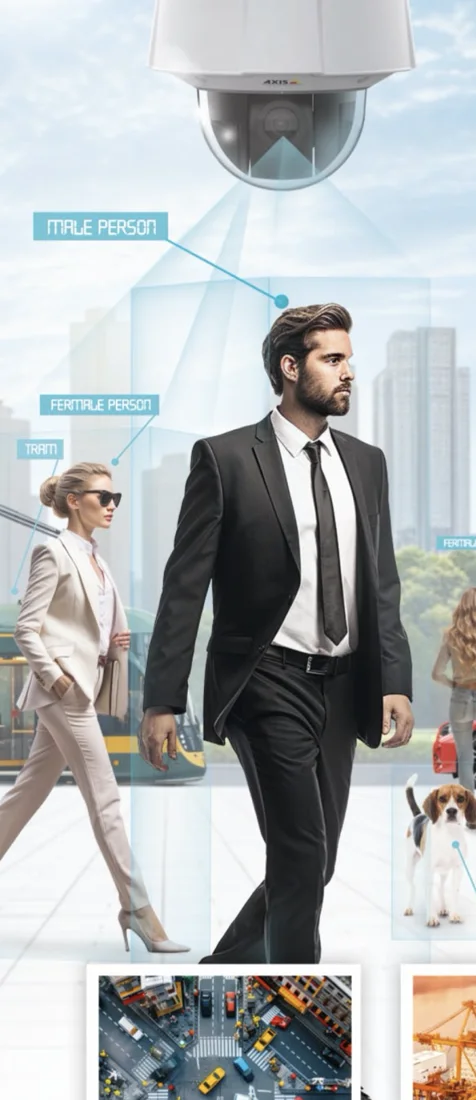
- AI video analyticsOur cameras and video systems support AI-based analytics that detect events and make evaluation easier.
- Data protection built inUser permissions, privacy masking, the four-eyes principle and data encryption are standard.
- ScalableYou can start with fewer than 10 cameras and expand to several servers and sites.
From image to event
Modern video technology reports what matters instead of merely recording.
- 01CaptureCameras deliver images by day and night.
- 02AnalyseAnalytics recognise people and vehicles.
- 03ReportRelevant events go to the control centre.
- 04DocumentRecordings can be searched for specific events.
What video surveillance is used for
HD resolution is now standard even on basic cameras. Video surveillance therefore does more than deter: it also allows meaningful alarm triggering and the analysis of video data.
IP cameras compensate electronically for glare, weather and poor lighting. For professional applications there are fixed cameras, dome cameras, pan-tilt-zoom (PTZ) cameras, thermal cameras and 4K cameras.
What we do for you
Planning is driven by your protection goals, the viewing angles, the focal lengths and the lighting. A sound camera plan prevents both over-equipping and blind spots.
- Consultation and project engineering
- Delivery and installation
- Training on the video software
- Maintenance and a round-the-clock emergency service line
- Assessment of existing systems and a migration concept for modernisation
Video analytics
Analytics modules generate events that make video data much easier to evaluate. Depending on the camera and system, the available functions include:
- Motion detection
- Object detection
- Vehicle number plate recognition, with a legal basis, information signs and a deletion concept
- Detection of loitering persons
- Protection of fences and site boundaries
- People counting
- Dynamic privacy masking
- Audio analytics
Video management for small and large systems
Many cameras produce a lot of data. The video management system stores it in compressed form and distributes the video streams to the devices you choose, such as a video wall, PC, tablet or smartphone.
A compact solution with a network video storage unit suits small to medium-sized systems. No PC or server is needed. Cameras and users connect to the storage unit over the network, and it can be operated from Windows, Mac, iOS and Android. With an internet connection, secured remote access is also possible. We set the retention period in line with your data protection concept.
For commercial and industrial sites we use networked video systems from Geutebrück. Distributed individual servers can be combined in one user interface. The system can start small and grow to several servers and sites.
Storage, resilience and data protection
Even with H.264 and H.265 compression, large numbers of cameras and high resolutions need a well thought-out storage concept. We use scalable systems whose capacity grows with the number of cameras and the resolution. Additional hard drives or storage racks can be added during operation.
AES encryption, role-based user rights and hardware redundancy safeguard data protection and resilience. This includes redundant power supplies, fans and data paths.
The GDPR does not specify a fixed retention period. The German data protection supervisory authorities generally regard up to 72 hours as appropriate, and longer retention needs to be justified. Number plates are personal data. Biometric facial recognition is only permitted in narrowly defined exceptional cases and is not part of our standard scope.
Manufacturers and systems
- Axis
- Geutebrück
Frequently asked questions
What determines the cost of video surveillance for company premises?
The number and type of cameras (fixed, dome, PTZ, thermal), the storage concept and whether AI analytics are required. For a reliable quotation we plan the camera positions at the site.
How many cameras does my site need?
With proper planning, often fewer than expected. What matters are the protection goals (recognise, identify, detect), viewing angles, focal lengths and lighting. We prepare a camera plan with a field-of-view simulation before any camera is installed.
Can I extend or modernise my existing video system?
Usually, yes. Existing IP cameras can often be taken over into a new video management system, and analogue equipment is replaced step by step in mixed operation. We assess what you have and prepare a migration concept with priorities and budget stages.
Who is allowed to view the video recordings?
Only a defined group of people on a need-to-know basis. We set up a roles and rights concept in the video management system, with logging of all access and the four-eyes principle for exports, agreed with the data protection officer and, where applicable, the works council.
Can the video system be connected to a monitoring centre?
Yes. When an alarm is triggered, the alarm receiving centre checks the live image to see whether it is a genuine break-in and only then starts the intervention. This reduces the number of false call-outs. Combined with AI analytics and loudspeaker announcements, intruders can often be driven off before they get in.