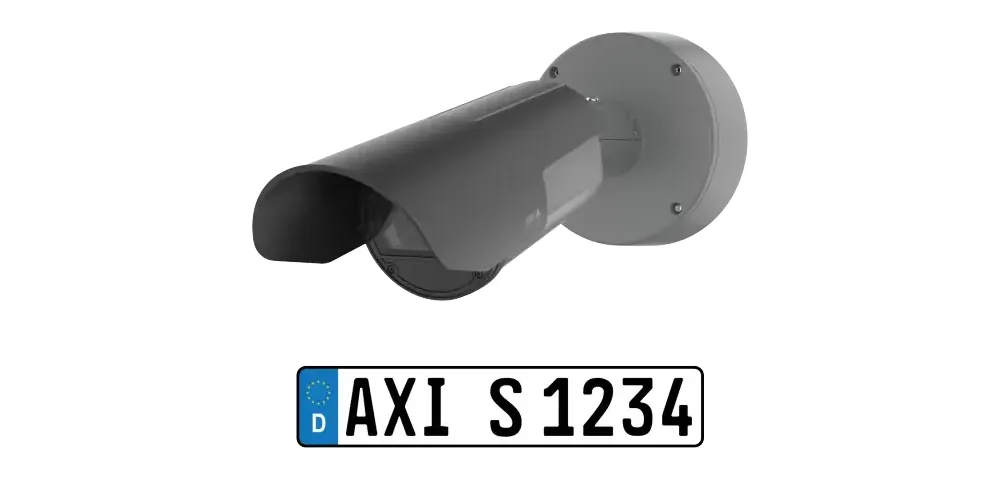

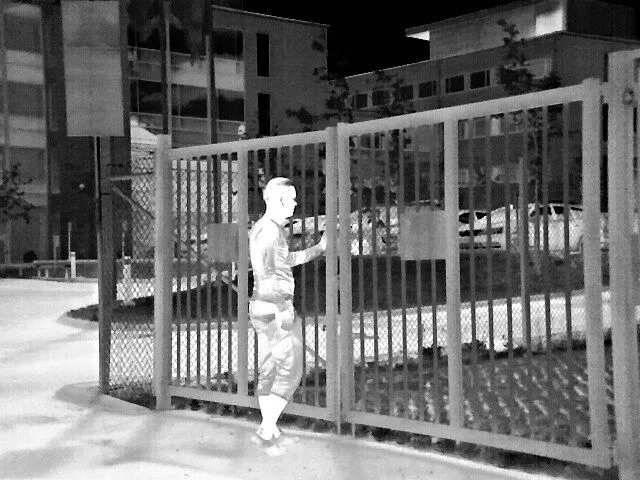
Axis thermal network cameras create their images from the heat radiated by objects, vehicles and people. This means they deliver usable surveillance images even in complete darkness.
- Manufacturer
- Axis
- Series
- Q19 and Q29
- MWIR
- approx. 3 to 5 µm
- LWIR
- approx. 8 to 14 µm
Detection yes, identification no
Thermal cameras are suited to detecting people, objects and incidents in the dark and in other difficult ambient conditions. Operators can use them to spot suspicious activity around the clock and take action.
However, the cameras do not deliver images that allow reliable identification. In a surveillance installation, thermal cameras and conventional cameras therefore complement each other.
No additional lighting needed
Thermal cameras do not need additional light sources. There is no need for conventional floodlights or infrared illuminators, which consume energy, create shadows and reveal their location.
Conventional day and night cameras, by contrast, need certain light conditions in the near-infrared range.
How the technology works
Like all cameras, thermal and temperature alarm cameras capture electromagnetic radiation and convert it into an image. Conventional cameras capture visible light with a wavelength between roughly 400 and 700 nanometres (0.4 to 0.7 µm). Thermal cameras are designed for radiation with a longer wavelength.
They generally work in one of two ranges:
- Mid-wavelength infrared (MWIR): roughly 3 to 5 µm
- Long-wavelength infrared (LWIR): roughly 8 to 14 µm