
Under certain circumstances, today's perimeter security technology can still trigger nuisance and false alarms. Sensor fusion combines data from different sensor types and is intended to detect events far more accurately than individual sensors.
Why a next step is needed
Today's perimeter security technologies have been taken to their practical performance limits. Even so, they occasionally trigger nuisance or false alarms. This impairs system performance and costs companies money.
Sensor fusion is still a relatively new technology in perimeter security, and it is often accompanied by misunderstandings.
What sensor fusion is
Sensor fusion combines simultaneous inputs from different sensor types in order to extract meaningful signals with greater accuracy than individual sensors can achieve in isolation. The concept is also familiar from other industries, such as self-driving cars or self-navigating robots.
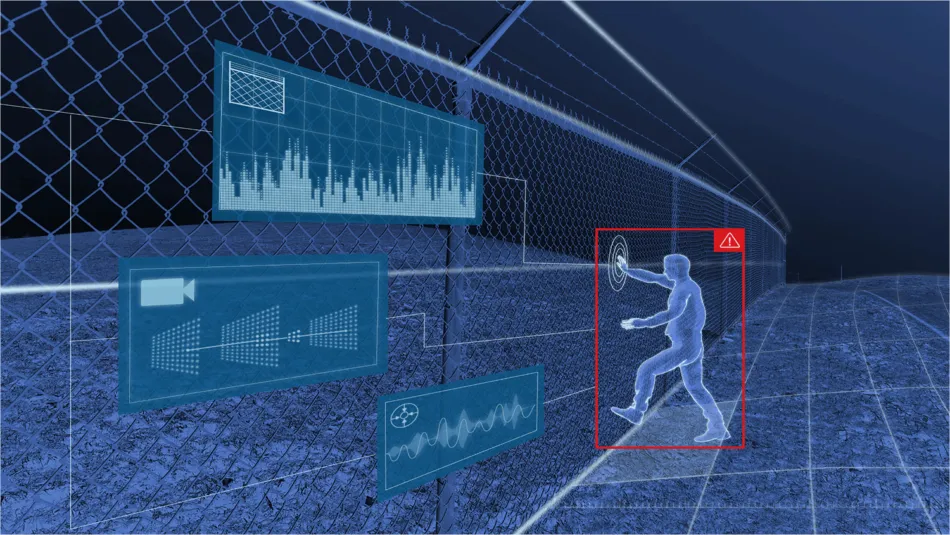
In perimeter security, data streams from surveillance cameras, fence sensors, volumetric sensors and other sources are analysed. This makes it possible to identify events such as intrusion attempts or even maintenance needs. The solution uses the strengths of the sensor technologies involved and reduces the drawbacks of each individual sensor type.
The difference from Boolean logic
A system only qualifies as sensor fusion if the inputs are combined in a particular way. A system that derives its decisions using simple Boolean logic, meaning operations such as AND, OR and NOT, is often presented as sensor fusion.
Such a system reports an intrusion, for example, when the fence sensor detects movement AND the camera records movement. A true sensor fusion system does not merely compare these true/false outputs from the individual sources, but examines the overall context.
Artificial intelligence and training
In a sensor fusion system, digital filters, probabilistic models and neural networks process the raw data from a combined sensor array. The algorithms need a great deal of parallel processing power and access to the low-level sensor data. This data is not available when the systems come from several vendors.
The systems have to be trained in advance with large volumes of data. Training covers not only simple variables but also qualitative attributes of the sensor data such as location, signal intensity and confidence level. Using historical information on the location and outcome of alarms, the system can keep learning.
The practical benefit
With enough data, the system learns which patterns indicate an event and which do not deserve attention. Two examples:
- Simultaneous fence vibrations and camera movement are recognised as a false alarm when wind and nearby non-threatening human activity are the cause.
- An intrusion alarm is raised with high reliability even when an experienced intruder tries to bypass a particular sensor.